If you’ve ever been around big rigs hauling extra-heavy loads—think construction equipment, prefab buildings, or oversized industrial parts—you’ve probably stared at a low-bed semi-trailer and wondered how it even turns without clipping a guardrail or side of the road. As a low-bed semi trailer supplier, I get questions about turning radius all the time, and it’s not just random truck driver trivia. It’s a make-or-break detail for anyone moving oversized freight: nail the turn radius, and you avoid delays, fines, or even accidents. Mess it up, and you’re stuck in a ditch with a $10,000+ load that can’t move. Low-bed Semi Trailer
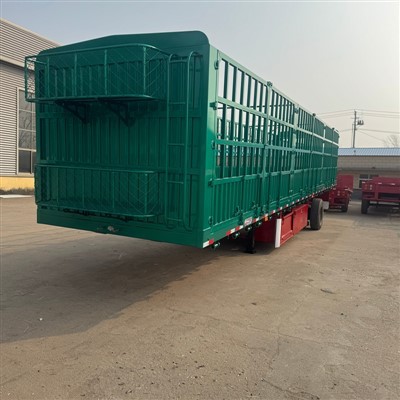
First, let’s keep this real: there’s no one-size-fits-all number here. A low-bed isn’t your standard 53-foot dry van trailer that glides down highways. Low-beds are built for heft—most empty they weigh 35,000 to 45,000 lbs, and when loaded, they push 80,000 lbs (the legal max on most U.S. roads, before overweight permits). That extra weight and the way they’re structured directly crushes the turning radius, which is the space a vehicle needs to make a full 90-degree turn without its wheels cutting the curb or its trailer sideswiping something.
Wait, let’s clarify two key terms people mix up, because this is where a lot of wrong info spreads online: curb-to-curb turning radius and road-to-road turning radius. Curb-to-curb is what you see on a car, measured from the center of the front steering wheel’s pivot to the point where the back of the trailer would touch a curb if you turned tight. Road-to-road is way bigger—it’s the distance between two parallel roads (or the edges of a two-lane highway) you need to turn from one to the other. For low-beds, these numbers are drastically different than a passenger car, and even different than a standard semi.
A standard 53-foot semi has a curb-to-curb turning radius around 55 to 60 feet. A low-bed? Let’s break that down by type. Most of what we supply are two common low-bed configurations: the fixed-gooseneck low-bed and the removable-gooseneck (RGN) low-bed. Fixed-gooseneck is the workhorse—no detachable neck, great for heavy, consistent loads. RGN is for when you need to load super tall or super long stuff, since you can drop the gooseneck to the ground and back the trailer under the load.
For a fixed-gooseneck low-bed (our most popular pick for repeat hauls), the curb-to-curb turning radius usually lands between 65 and 75 feet. Wait, that’s 10 to 15 feet wider than a regular semi? Yup, and here’s why: low-beds have a longer wheelbase than standard trailers. A standard semi’s wheelbase (distance between the front axle and the rear trailer axle) is around 40 feet. A fixed-gooseneck low-bed? 48 to 52 feet. That extra length means the trailer’s rear end has a wider “sweep” when turning—think of how your elbow swings farther when you stretch your arm out fully, vs. when it’s bent. If you’re turning left in a low-bed, the back of the trailer will drift way left, not straight back like a shorter trailer. And if you’re turning right, the front of the gooseneck might clip a curb if you don’t give it enough space.
Now the RGN low-bed, which we use for oversized loads like bulldozers or 80-foot wind turbine blades? Its curb-to-curb turning radius jumps even more—75 to 85 feet. Why? RGNs have a slightly longer wheelbase too, plus the removable gooseneck adds a little extra length at the front. We recently had a customer moving a 70,000-lb excavator on an RGN, and he told us he had to take a 15-mile detour just to make a turn that a regular semi would have nailed in 10 feet. That’s the real cost of a wider turning radius—time, fuel, and permit fees to take routes big enough for these trailers.
But here’s the thing: that’s the theoretical number from engineering specs. The actual turning radius on the road varies a ton, depending on three big factors you can’t just pull off a brochure. First, the load you’re hauling. If you’re running light (say, 5,000 lbs of steel beams that don’t sit high), the turning radius is a little tighter—maybe 5 feet less than the empty spec. But if you’re loaded to the legal max with a tall, wide load? That adds 10 feet or more, because the weight shifts the trailer’s center of gravity back, making it harder to maneuver tight turns. Second, road conditions. Paved, flat roads with smooth curbs? Your turning radius is exactly what the spec says. Gravel roads, steep hills, or roads with narrow shoulders? Add another 10 to 15 feet—you can’t count on having extra space if the shoulder is loose or uneven. Third, the tractor you’re pairing with the low-bed. A day cab tractor (shorter wheelbase, no sleeper) will give you a tighter turning radius than a big sleeper cab with a long wheelbase. We always advise customers to match their tractor’s wheelbase to their trailer: a shorter day cab for tight construction sites, a longer sleeper for highway runs with big loads.
Wait, let’s bust a common myth here: some people think a “low” bed means a tighter turn. No, that’s not true. The low profile is for loading tall stuff, but it doesn’t change the wheelbase. The only way to get a tighter turning radius on a low-bed is to opt for a “low-clearance” version with a shorter wheelbase, but that sacrifices capacity—you can’t haul as much weight on a shorter wheelbase low-bed, so it’s a tradeoff. For most heavy haulers, that tradeoff isn’t worth it.
Now, why does this matter to you? If you’re a contractor moving excavators between job sites, a farm supply hauler moving combines, or a freight broker arranging oversized loads, skimping on knowing your low-bed’s turning radius will cost you. Last year, we had a customer who rented a cheap low-bed from a no-name supplier, thought the turning radius was 60 feet like a regular semi, and got stuck turning onto a job site road that only had 55 feet of clearance. He had to call a local towing company with a specialized big rig to pull him out, which cost $2,500 on top of the rental fee. That’s the kind of mistake we help you avoid when you work with us as your low-bed semi trailer supplier.
Let’s talk about what goes into the engineering of that turning radius, because it’s not just a random number. When we design our low-beds, we work with axle manufacturers to tune the wheelbase, the kingpin setting (that’s the pivot point where the gooseneck connects to the trailer), and the trailer’s rear overhang. The kingpin is a big one: moving the kingpin forward on a fixed-gooseneck low-bed tightens the turning radius, but you have to balance that with weight distribution—if the kingpin is too far forward, the trailer’s rear axle gets overloaded, which is illegal and dangerous. It’s a delicate balance, which is why cheap, untested low-beds from overseas suppliers often have wonky turning radii that don’t match their specs.
We also test every low-bed before it leaves our yard, using a 90-degree turn test in our private lot to confirm the actual turning radius matches the engineering draw. No guessing, no fudging numbers to make the trailer sound more maneuverable. For example, our standard fixed-gooseneck low-bed passes that test with a 70-foot curb-to-curb turning radius—meaning you need at least 70 feet of unobstructed space to nail a tight turn, no detours needed.
Now, what about road-to-road turning radius, which is what state DOTs use to approve oversized load permits? For our fixed-gooseneck low-beds, that’s around 120 to 130 feet, and for RGNs, it’s 130 to 140 feet. That means to turn from one two-lane road to another, you need a stretch of road that’s at least that long—no sharp turns, no intersections with tight radii. DOTs will actually check your turning radius spec before they issue your permit, so if your low-bed has a wider turning radius than you listed on your permit application, you could get fined or turned around at the state line.
Let’s wrap this up with practical takeaways, because that’s what you care about. First, don’t take a supplier’s word for the turning radius—ask to see the test results, or test it yourself in a big empty lot if you’re renting. Second, match your low-bed type to your routes: if you’re running through small construction sites with tight turns, go for a fixed-gooseneck low-bed over an RGN, and pick a shorter wheelbase if you can handle slightly lower capacity. Third, account for your load: add 5 to 10 feet to the theoretical turning radius when you’re carrying a tall, heavy load, because that will shrink your maneuverability.

As your go-to low-bed semi trailer supplier, we don’t just sell you a trailer and walk away. We include the official turning radius test results with every unit, and we offer free route consulting for customers who need to plan runs with tight turns or narrow roads. Whether you’re buying your first low-bed, upgrading your fleet, or just have questions about turning radii or load capacity, we’re here to help you avoid those costly (and annoying) mistakes. If you want to chat through what low-bed is right for your hauls, reach out to our team to go over your needs, your route, and how we can get you set up with a trailer that works for your operations.
Wheeled Excavator References:
- Federal Highway Administration. (2022). Commercial Vehicle Turning Radius Guidelines for Oversized Loads. U.S. Department of Transportation.
- Heavy Equipment Transport Association. (2021). Low-Bed Semi-Trailer Engineering Specifications and Maneuverability Standards. HETA Publications.
- North American Trailer Manufacturers Association. (2023). Wheelbase and Turning Radius Tradeoffs for Heavy-Duty Trailers. NATA Technical Bulletin.
- State Department of Transportation. (2022). Oversized Load Permit Requirements: Turning Radii Exceptions. Individual State DOT Manuals.
Shandong Xinyang Special Purpose Vehicle Manufacturing Co., Ltd.
As one of the most professional low-bed semi trailer manufacturers and suppliers in China, we’re featured by quality products and good price. Please rest assured to buy cheap low-bed semi trailer made in China here from our factory. Contact us for more details.
Address: Quanpu Industrial Park, Liangshan County, Jining City, Shandong Province.
E-mail: ensonzhouau@gmail.com
WebSite: https://www.trustmytruck.com/
